
REELFOOT LAKE HOME PAGE
Shop Reelfoot Lake--Tennessee
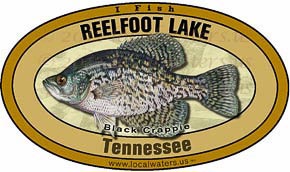 Reelfoot Lake Crappie sticker Tennessee fishing decal
Reelfoot Lake is an extremely shallow natural lake located in the northwest portion of Tennessee. Much of it is really more of a swamp, with bayou-like ditches (some natural, some man-made) connecting more open bodies of water called basins, the largest of which is called Blue Basin. Reelfoot Lake is noted for its bald cypress trees and its nesting pairs of bald eagles. It is the site of Reelfoot Lake State Park. Lake Isom, a similar, smaller lake to the immediate south, is a National Wildlife Refuge area.
Reelfoot Lake was formed when the region subsided (dropped in elevation) during the New Madrid earthquakes of 1811?1812. Many eyewitnesses reported that the Mississippi River flowed backward for 10?24 hours to fill the lake. The earthquakes resulted in several major changes in the landforms over a widespread area with shocks being felt as far away as Quebec.
Reelfoot is the only large natural lake in Tennessee, and gives its name to Lake County, Tennessee, in which it is located. Until 2003,[citation needed] Reelfoot was the world’s only legal commercial fishery for crappie, a species of sunfish, which was served in restaurants near the shore. The area is popular for recreational boating and fishing.
Since 1930, water levels in the lake have been regulated by the construction and operation of a spillway at the southern end where the Running Reelfoot Bayou flows out of it. This structure was controversial when first built, and an abortive attempt was made to blow it up by local residents in 1939. The 80-year-old structure is now regarded as obsolete by both the U.S. Fish and Wildlife Service and the United States Army Corps of Engineers, and there are plans to replace it.
Poor agricultural practices have resulted in siltation of the lake occurring far more rapidly than it should, as it was common practice for cotton and soybeans to be planted up to the water’s edge until governmental agencies purchased the entire shoreline and forbade the practice. Siltation is nevertheless accelerated by the local custom of “burning out” the adjacent ditchlines every fall.
Reelfoot Lake is said to be named for an Indian chief who had a deformed foot and was nicknamed “Reelfoot” by settlers in the early 1800s. A Chickasaw native American legend states that the name originated from a prince of a Chickasaw tribe inhabiting the present West Tennessee who was born with a deformed foot and walked with a rolling motion, so was nicknamed “Kolopin,” meaning Reelfoot. When he became chief, Reelfoot determined to marry a Choctaw princess, but her father would not permit it. The Great Spirit warned Reelfoot that if he attempted to kidnap the maiden, his village and his people would be destroyed. Reelfoot disobeyed the Spirit, and seized the princess by force and carried her to Chickasaw territory, where he arranged a marriage ceremony. In the middle of the ceremony, the Great Spirit stamped his foot in anger, causing the earth to quake, and the Father of the Waters raised the Mississippi River over its banks, inundating Reelfoot’s homeland. The water flowed into the imprint left by the Spirit’s foot, forming a beautiful lake beneath which Reelfoot, his bride, and his people lie buried.
Other origins are also cited, for example, in his 1911 story “Fishhead,” Irvin S. Cobb claimed the lake “[took] its name from a fancied resemblance in its outline to the splayed, reeled foot of a cornfield Negro.” Though the legend is about the Chickasaw and Choctaw tribes which inhabited the area, these tribes left around the early 1300s only using it as hunting grounds. By examining early maps of Tennessee, Map of the Southern States of America, 1795 we see where Reelfoot Lake is now the Red Foot River. In a later map after the lake is formed, Tennessee and Kentucky 1835 the body of water is called Wood Lake because of all the standing trees in the water. It is likely then, that over the next few years (even before 1835) map makers sepearated the ‘d’ in Red Foot and it became an ‘e’ and ‘l’, making it Reel Foot Tennessee 1827.
Wiki/Creative Commons License for description above only:http://creativecommons.org/licenses/by-sa/3.0/
Reelfoot Lake is widely known for it’s crappie fishing. Many other species of game fish are abundant as well. The area around Reeelfoot Lake had a special exemption that allowed establishments to serve crappie on their menu. No other area of TN allowed game fish to be served. This practice was stopped in the early 2000’s.
Boaters new to Reelfoot Lake should use caution because the lake is extremely shallow and bald cypress knees rise up to just below the surface in many areas. Consider hiring a local guide, buying maps and charts and consulting with local people before your launch.
The lake is becoming famous for the continuing recovery of it’s bald eagle population and in the last twenty years has begun attracting eagle tourists to go along with the famed crappie fishing and duck hunting. Reelfoot Lake is a sportperson’s paradise.
Please consider showing your appreciation of Reelfoot Lake by picking up some litter during your next visit, many hands make light work.