
TELLICO LAKE HOME PAGE
Shop Tellico Lake--Tennessee
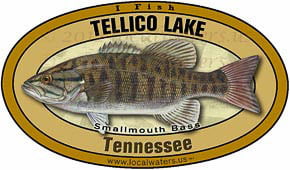 Tellico Lake Smallmouth Bass sticker Tennessee decal
Tellico Reservoir, also known as Tellico Lake, is a reservoir in Tennessee, created by the Tennessee Valley Authority (TVA) in 1979 upon the completion of Tellico Dam. The dam impounds the Little Tennessee River and the lower Tellico River. While TVA is careful to refer to its artificial lakes as reservoirs (such as “Tellico Reservoir”), common usage tends to refer to the reservoir as “Tellico Lake”. The lake is approximately 16,000 acres in surface area and provides 357 miles of shoreline.
Tellico Reservoir was the last major reservoir created by the TVA, in part due to the snail darter controversy. The completion of Tellico Dam was nearly halted by a landmark decision by the Supreme Court regarding the Endangered Species Act. After Congress specifically exempted Tellico Dam from the Endangered Species Act, the work was finished and Tellico Reservoir created.
The Tellico Reservoir inundated several Native American sites, including the historically significant sites of Chota and Tanasi. The controversial Bat Creek inscription was also discovered adjacent to this lake.
Description courtesy of wiki
The TVA Story of Tellico Lake
Tellico Reservoir was planned as an extension of nearby Fort Loudoun Reservoir. Tellico Dam serves to divert water through a short canal into Fort Loudoun, linking the two reservoirs in their joint functions of flood damage reduction, power production, and improved navigation. They help regulate flooding downstream, especially at Chattanooga. The canal also allows barges to enter the Little Tennessee River without a lock, thus significantly increasing commercial barge operations in the Valley.
Several recreation areas that include boat ramps, day-use areas, fishing areas, and campgrounds are available at Tellico. The reservoir offers excellent trout and bass fishing.
On Tellico’s banks is a reconstruction of the original Fort Loudoun, which was built by the British during the French and Indian War. It was named for John Campbell, the fourth Earl of Loudoun, commander-in-chief of the British forces in North America at the time. Another nearby historic attraction is the Sequoyah Birthplace Museum, honoring the Cherokee genius who invented the Cherokee alphabet.
courtesy TVA
The Great Controversy during the construction of Tellico Lake Dam
Construction of the Tellico Dam was controversial and marks a turning point in American attitudes toward dam construction. Until the 1960s and 1970s few questioned the value of building a dam; indeed, dams were considered to represent progress and technological prowess. During the twentieth century the United States built thousands of dams.[2] By the 1950s most of the best potential dam sites in the United States had been utilized and it became increasingly difficult to justify new dams, but government agencies such as TVA, the Bureau of Reclamation, and the Army Corps of Engineers continued to construct new dams. In the 1970s, the era of dam-building ended. The Tellico Dam case illustrates America’s changing attitudes toward dams and the environment.
Construction of the dam was delayed when a small endangered fish called the snail darter was discovered on the Little Tennessee River. Dam opponents brought a lawsuit under the Endangered Species Act. The case, Tennessee Valley Authority v. Hill, 437 U.S. 153 (1978), made it to the Supreme Court of the United States. In Hill, the Supreme Court affirmed, by a 6-3 vote, an injunction issued by a lower court to stop construction of the dam. Citing explicit wording of the Endangered Species Act (ESA) ensuring habitat for listed species is not disrupted, the Court said “it is clear that the TVA’s proposed operation of the dam will have precisely the opposite effect, namely the eradication of an endangered species.”[3] In the ensuing controversy, the Endangered Species Committee (also known as the “God Squad”) was convened to issue a waiver for ESA protection of the snail darter. In a unanimous decision, the Committee refused an exemption of the Tellico Dam project. Charles Schulze, the chairman of the President’s Council of Economic Advisers, later cited economic assessments that despite the Tellico Dam being 95% complete, “if one takes just the cost of finishing it against the benefits and does it properly, it doesn’t pay, which says something about the original design.”
After a long battle Congress finally exempted the Tellico Dam from the Endangered Species Act as an amendment in an unrelated bill. The gates were closed on the dam and Tellico Lake (a reservoir) began to form in 1979. Remnant populations of the snail darter were later located in other streams.
The dam flooded the locations of the 18th century Overhill Cherokee towns of Chota, Tanasi, Toqua, Tomotley, Citico, Mialoquo and Tuskegee, as well as several prehistoric sites dating to as early as the Archaic period. The port of Morganton was also submerged. Fort Loudoun was excavated; dirt was deposited to raise the site 17 feet (5 m), and the fort was rebuilt in its original location.
Tellico Dam does not produce any electricity. However, the Tellico Dam complex directs almost all of the flow of the Little Tennessee River into a canal that enters the Tennessee River on the upstream side of Fort Loudoun Dam, thus adding 23 MW to the hydropower capacity at that dam. Courtesy wiki
Tellico Village and other lakefront residential communities have been built along the shores of Tellico Lake recently and the area is specially promoted for Industrial Development by the Tellico Reservoir Development Agency (TRDA)
Please consider showing your appreciation of Tellico Lake by picking up some litter during your next visit, many hands make light work.